
Choosing Stone for Cladding: A Practical Guide for Saudi
Choosing stone for cladding in Saudi Arabia: how to weigh heat, sand, thickness, fixing method, finish and details before you order. A practical guide.
Choosing stone for cladding is not only a question of colour. A facade stays outside for decades in strong sun, wind-blown sand, rare but heavy rain and big day-to-night temperature changes. The stone, the thickness, the fixing method and the small details all need to suit those conditions. This guide covers the points to settle before you order.
Start with the building, not the sample
Before looking at samples, collect the basic facts:
- Is the wall concrete, block or a steel frame?
- How high is the building, and which sides face the sun and the prevailing wind?
- Is there insulation or a waterproofing layer behind the cladding?
- What weight can the structure carry?
The stone has to be designed as part of the whole wall. The Saudi Building Code for loading (SBC 301) says <cite index="7-4">components and cladding must be designed to resist forces such as earthquake and wind</cite>. Your consultant or engineer should confirm the loads and the fixing design. Fire requirements for the wall build-up, including any insulation behind the stone, also need to be checked with the consultant against the applicable code. Stone itself is non-combustible, but the assembly behind it may not be.
Marble, granite, limestone, porcelain: what each is good for
Granite is dense and hard, with low water absorption. It handles sun, sand and cleaning well, so it is a common choice for bases, entrances and areas people touch or lean on.
Marble gives a refined look but varies more in veining and tone. Some marbles stain or lose their polish outdoors. Honed or brushed finishes usually age better on exterior walls than high-gloss polish.
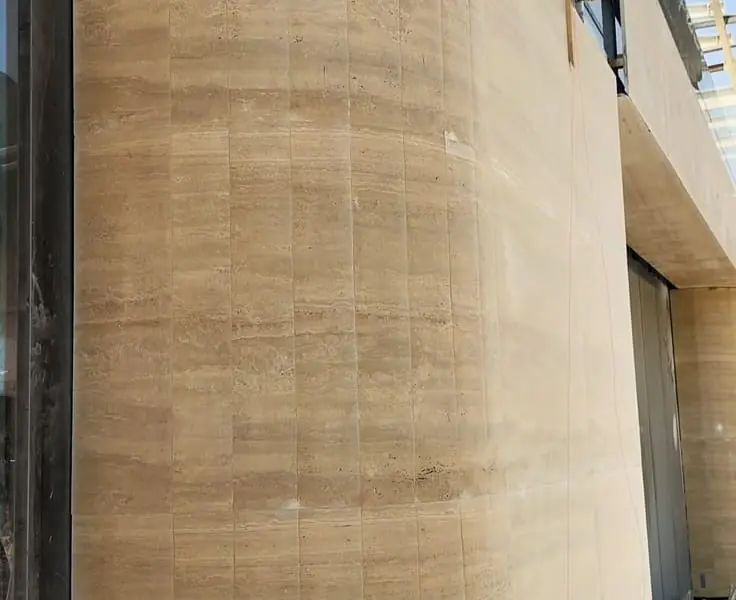
Limestone, travertine and Riyadh stone have a warm, natural look that suits the local setting. They are generally softer and more porous than granite, so ask about absorption, sealing and how the stone behaves where sand and moisture meet.
Porcelain is consistent in colour and size, and it comes in large formats. It suits projects that need a uniform look. Check that the product is rated for exterior facade use, and that the fixing system suits its size and weight.
Whichever you choose, ask for the supplier's technical data for the exact product and compare it with what your consultant specified.
Thickness and size
For facade cladding, 20 to 30 mm is the usual range for stone. Heavy panels may need 30 to 40 mm. Floor stone is often 20 mm, but do not assume a floor product suits a wall.
Common panel sizes include 30x60, 40x80 and 60x90 cm. Larger porcelain slabs such as 60x120 or 120x120 cm are also used. A different size or thickness is a different product. It changes the weight, the anchor layout, the waste and the price, so always state both when you ask for a quotation.
Dry-fix or wet-fix
Dry-fix systems hold each panel on stainless steel anchors or brackets, typically four per panel. They suit larger, heavier panels and higher walls. They also leave a gap behind the stone, and that helps with moisture and movement.
Wet-fix systems use adhesive or mortar. They suit smaller, thinner pieces on lower walls. One technical specification we reviewed allows adhesive fixing only for thin, small-format natural stone tiles. If your panels are large or heavy, ask your consultant to confirm that adhesive alone is acceptable.
In both systems, the fixings and the substrate preparation matter as much as the stone.
Planning for heat, sand and movement
Stone expands and contracts with temperature. One technical guide on exterior tile and stone facades notes that <cite index="3-6">a lack of adequate movement joints is one of the most common causes of facade failures</cite>. In a Saudi summer, with hot surfaces by day and cooler nights, joints are not optional.
Other practical points:
- Colour: Very dark stone gets hotter in direct sun. Look at your samples outdoors, not only under showroom lights.
- Finish: Rougher finishes hide dust but can hold it. Polished surfaces show every mark. Choose a finish you can clean easily.
- Absorption and sealing: Ask whether the stone needs a sealer and how often.
- Sand: Windblown sand wears soft finishes over time. Test a sample if the wall will be exposed.
- Water: Plan drainage at the base, behind the cladding and around openings.
Details people forget
Quotes often miss the pieces that finish a facade. Before you approve a quantity, check the drawings for:
- skirting and base courses
- sills and window surrounds
- coping on parapets
- returns, corners and cut edges
- steps and risers, if any
- sealant at joints
- protection of finished stone from site traffic and other trades
Each of these needs its own stone pieces, cutting and labour.
Allow for waste and order extra
Cutting waste is normal. Plain walls with few cuts usually need 10 to 15% extra. Book-matched stone, many cuts or curves can need 15 to 20%. At bid stage, before an engineer has checked the drawings, 15 to 18% is a reasonable allowance. Stone also varies between batches, so order enough from the same lot to finish the job. A small spare quantity helps with future repairs.
Ask for a mock-up
A small sample board is not the same as a finished wall. A mock-up panel on site lets you check colour variation, joint width, finish and the fixing method in real light. It is easier to change a mock-up than a finished facade.
Talk to us early
Al-Swati Contracting supplies and installs marble, granite, natural stone and porcelain for flooring and facade cladding in Riyadh, Dammam and Al-Hassa. If you are choosing stone for cladding and want to talk through options, quantities or fixing methods, send us your drawings or a description of the project. We will tell you what we can see from them and what still needs checking.
Phone: 0511826313 Email: hussainkhan@al-swaticontracting.com Website: al-swaticontracting.com